

Beyond Engagement: Finding the Right Balance Between Reach and Immersion


This blog explores how deeper engagement strengthens connections, but must be balanced with scale to ensure experiential programs deliver meaningful reach and ROI.
Experiential marketers love to talk about engagement. The more interactive, personalized, and memorable an experience becomes, the more successful it is assumed to be. And to a point, that is true.
Research has consistently shown that deeper engagement creates stronger memories, higher emotional connection, and greater brand impact. A recent Delphi study published in the Journal of Brand Management identified "depth of immersion" as one of the key mechanisms that drives experiential marketing effectiveness. The study found that consumers who become more immersed in an experience tend to develop stronger brand salience and more meaningful connections with the brand. (Springer Link)
IMI’s experiential database has shown that engaging event experiences can increase brand loyalty, purchase intent, and event recall as attendees become active participants rather than passive observers.
The challenge is that a deeper engagement comes at a cost.
As experiences become more elaborate, throughput or footfall often declines. A five-minute interaction can serve twelve people per hour. A fifteen-minute interaction can serve only four. A highly personalized twenty-minute experience may create a stronger impact on each participant, but it dramatically limits the total number of people who can engage with the brand.
This creates an important question that many marketers overlook: Is the increase in impact per participant enough to offset the reduction in total participants?
Consider something like a traditional street sampling program. The interaction is much shorter it may be less than a minute. Brand recall may not be as strong as a fully immersive activation, and the emotional connection may be shallower. Yet a sampling team places a product directly into the hands of thousands of consumers in a single day.
IMI’s experiential database has shown that all levels of experiential campaigns can be successful (and even as effective as things such as traditional passive advertising – but that is another conversation). Getting the consumer to interact with your brand has very positive impact both attitudinally and behaviorally.
The most successful experiential programs strike a balance between depth and scale. Rather than designing an activation solely around creating the deepest possible interaction, marketers actually need to start in reverse. Understand the expected value you expect from every positive interaction, do the math around what your activation budget is, and then build your event to ensure a positive ROI and a successful experience for your attendees.
A quick way that you might think about your next experiential activation would be as follows:
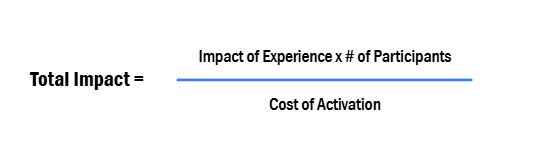
An activation that creates an unforgettable experience for 500 people may not outperform an activation that creates a meaningful experience for 10,000 people.
This does not mean deeply immersive experiences are the wrong choice. In some situations—premium brands, product launches, high-value customers, or media-generating moments—depth can take priority. But for many brands, particularly those seeking awareness, trial, or mass-market growth, throughput deserves a seat at the planning table.
Before finalizing your next activation, ask not only, "How memorable will this be?" but also, "How many people will actually experience it?"
There is a lot of thought that is put into every activation, just make sure that you and your brands are thinking about every aspect of activation from the engagement to the flow through. It can be easy to focus on the attendee engagement and forget about traffic numbers.
Because for experiential marketing, the goal more than maximizing engagement per person, it’s to maximize the total brand impact.